
 Free Delivery & Return
 365-Day Returns
 10 Million Happy Customers
 500,000 Products in Stock


Rugs (964)


How To Choose The Right Rug For Your Home
A rug does more than cover a floor - the right one pulls your furniture together, marks out a zone in an open-plan room, and sets the mood for the whole space. Getting there is a matter of working through four decisions in order: size, shape, material and pile height, each shaped by the room it's going into and how you actually use it day to day.
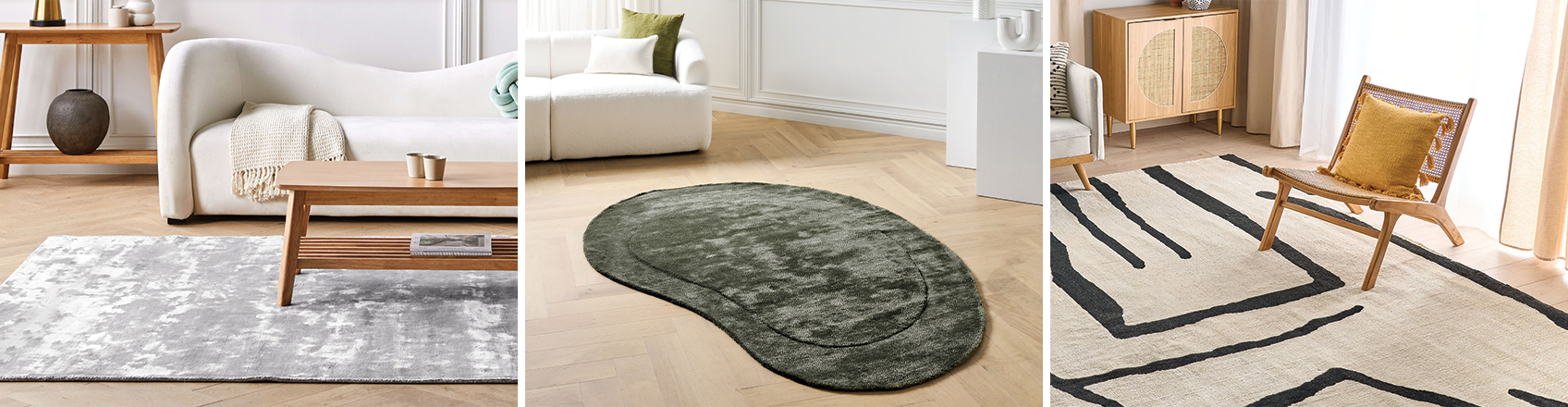
What's the right rug size for each room?
Rugs are sold in a handful of standard sizes, and knowing them makes shopping much quicker. The most common are 160x230cm, 200x300cm and 300x400cm, with smaller options like 60x180cm or 120x170cm for compact rooms or layered looks. Each room has its own rule of thumb for which size works best.
Living room rug size
Choose a rug large enough that at least the front legs of every sofa and armchair in your seating group rest on it - this ties the furniture together, rather than leaving it floating on bare floor. As a guide: 160x230cm suits a small living room, or works well under a coffee table in a larger one; 200x300cm is a comfortable fit for a medium-sized room, large enough for a three-seater sofa and two chairs to sit with their front legs on the rug; 240x340cm or 300x400cm suits a large or open-plan living room, where the rug needs to anchor the whole seating area, including the back legs of the sofa.
| Living room size | Suggested rug size | Placement |
|---|---|---|
| Small / compact (up to 12 square meters) | 160 x 230cm | Front legs of sofa and chairs on the rug, or rug placed under the coffee table only |
| Medium (up to 20 square meters) | 200 x 300cm | Front legs of all seating rest on the rug |
| Large / open-plan (above 20 square meters) | 240 x 340cm or 300 x 400cm | All four legs of every seating piece rest on the rug |
Dining room rug dimensions
Your dining rug needs to extend at least 60cm beyond every side of the table, so chairs stay on the rug even when pulled right out. A standard six-seater table typically calls for a 200x300cm rug; a four-seater can work with 160x230cm, while an extendable or eight-seater table usually needs 240x340cm or larger. Always measure your table at its most extended, since a rug that's too small will catch chair legs and wear unevenly at the edges.
Bedroom rug placement
In the bedroom, choose a rug that extends beyond the sides and foot of the bed, so your feet land on something soft the moment you get up. For a double or queen bed, a 200x300cm rug positioned to extend roughly 40-50cm beyond each side works well; a king-size bed needs 240x340cm or 300x400cm for the same coverage. A popular layout places the rug under the lower two-thirds of the bed, starting about a third of the way down from the headboard. In smaller bedrooms, two runners (around 60x180cm) on either side of the bed give the same effect, without the need to shift heavy furniture.
Hallway and runner rug sizing
Runners work best when sized to the hallway itself: leave 15-20cm of bare floor visible at each end and along the sides, rather than running the runner wall to wall. Standard runner widths are 60-90cm, with lengths made to fit longer corridors. A well-fitted runner covers the main walking path, protects your flooring from wear, and adds a soft landing underfoot through the busiest part of the home.
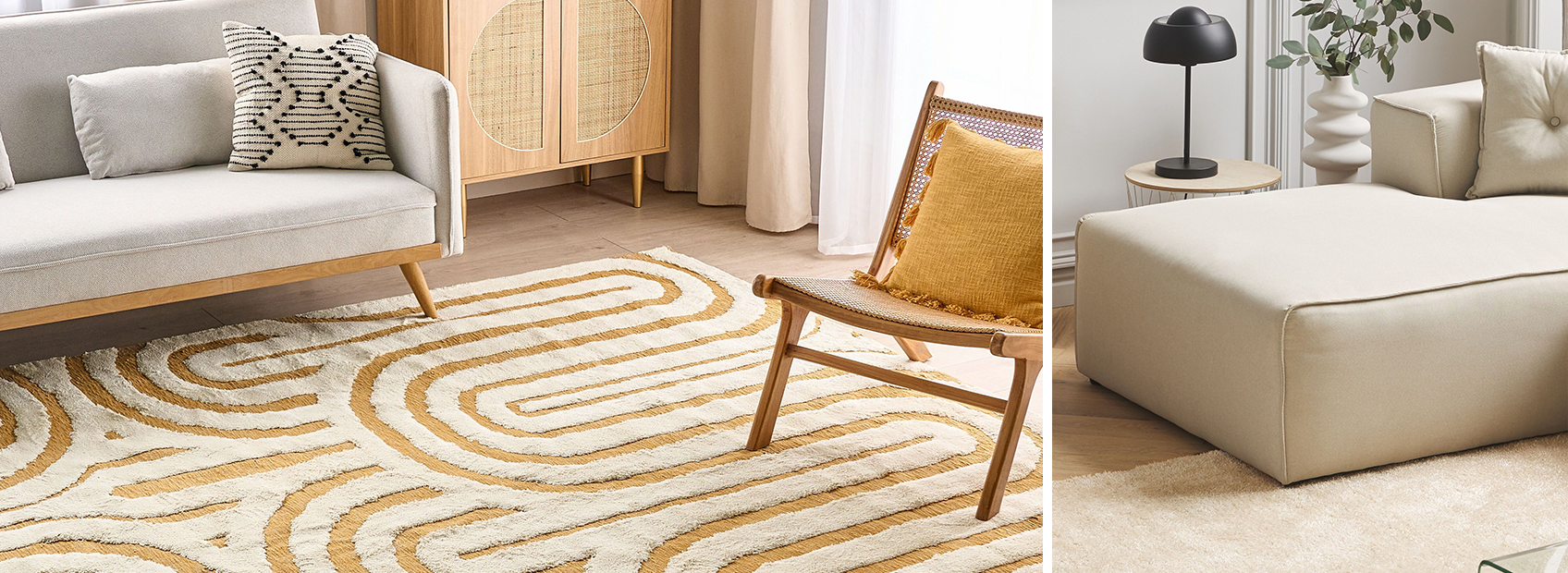
Read more: our dedicated rug size guide
Which rug shape suits your space?
Shape is usually decided after size, but it has just as much impact on how a rug reads in a room. Each shape brings its own strengths and limitations, summarised below.
| Shape | Best fit | Advantages | Disadvantages |
|---|---|---|---|
| Rectangular | Most living rooms, bedrooms and dining spaces, since sofas, beds and tables are almost always rectangular | Easiest to align with furniture and the most widely available in every size | Offers little visual contrast in a room already full of straight lines |
| Round | Round dining or side tables, reading corners, or under a pendant light | Softens a room of straight lines and works well in smaller, contained areas | Doesn't extend into corners, so it rarely suits a large or open-plan zone |
| Square | Square rooms or a symmetrical seating group, such as two armchairs facing each other across a square coffee table | Fills a symmetrical layout evenly with no wasted floor at the sides | A poor fit for any rectangular room or furniture arrangement |
| Irregular | A standalone statement piece in front of a chair, beside a bed, or layered over a larger neutral rug | Adds character and a distinctive look | Its uneven outline doesn't align with straight furniture edges, so it rarely works as the main anchor for a full seating group |
Take a moment and read more about hot trending irregular rugs
Which rug material is best for your home?
Material shapes how a rug feels underfoot, how well it holds up to daily use, and how much upkeep it needs. The right choice comes down mainly to how much foot traffic the room gets, and how exposed it is to moisture or spills.
Soft wool rugs
Wool combines softness with resilience - its natural fibres resist staining, spring back into shape after heavy use, and hold their colour for years of daily wear. It copes confidently with high-traffic areas, making it a solid choice for living rooms, bedrooms and hallways alike.
Eco-friendly jute rugs
Jute is a natural plant fibre that's strong, biodegradable, and visually textured, adding a rustic or bohemian note to a room. It isn't suited to humid environments, since moisture weakens the fibres over time, so jute works best in dry, lower-traffic spaces such as living rooms or entryways.
Practical cotton rugs
Cotton is lightweight, affordable, and easy to clean, with smaller sizes often machine-washable at home. It's less durable than wool or synthetic fibres under heavy daily use, so it suits bedrooms, kitchens, or other lower-traffic areas rather than a busy main living space.
Stain-resistant synthetic rugs
Synthetic fibres such as nylon, polyester and polypropylene are engineered to resist stains and fading, and hold up well against pets, children and heavy foot traffic. They're available in a wide range of colours and patterns, making them a practical option for busy family households.
Best for busy homes
Wool or synthetic fibres
Both resist stains and heavy foot traffic well, making them the safer pick for households with children, pets, or a high-use living room.
Best for dry, low-traffic rooms
Jute or cotton
Natural texture and easy care suit bedrooms or quiet living spaces, but both are more sensitive to moisture and heavy wear.
Shop now: wool rugs and jute rugs
What pile height should I choose?
Pile height is the length of the fibres above the backing, and it's one of the biggest factors in day-to-day practicality, affecting everything from cleaning to how well doors clear the rug.
| Pile height | Feel | Best for | Watch out for |
|---|---|---|---|
| Low-pile / flatweave | Flat, firm surface | Easiest to vacuum and clean, sits flush under doors, and suits high-traffic zones or allergy-prone households | Offers less cushioning underfoot than a deeper pile |
| High-pile / shag | Soft, plush and warm | Cosy underfoot in bedrooms and quiet living spaces | Traps dust and dander more readily, takes longer to vacuum thoroughly, and is worth avoiding for allergy sufferers or busy rooms |
How do I care for a rug?
A few simple habits keep a rug looking and performing well for years:
- Vacuum regularly to clear out dirt and grit before it works down into the pile and wears the fibres from the inside
- Blot spills immediately with a clean, dry cloth rather than rubbing, since rubbing pushes the stain deeper into the fibres
- Rotate the rug 180 degrees every 3-6 months to even out wear from foot traffic and fading from sunlight
- Add a rug pad underneath on hard floors to reduce slipping and cut down on wear in high-traffic areas
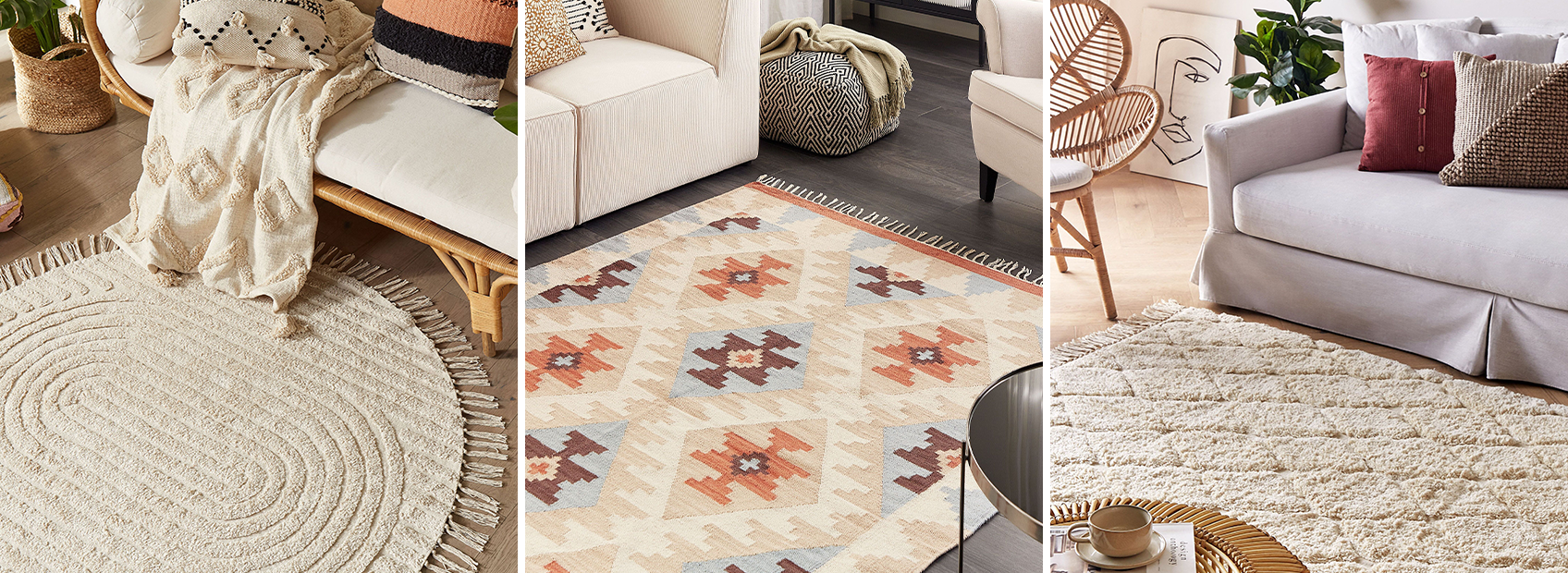
Read more: how to hang a rug
In short
What to check before buying a rug
Before you order, run through this quick checklist - it pulls together the size, shape and material advice above, so you can be confident your new rug will fit the room and suit the way you actually live in it.
- Measure your room, and plan for 20-40cm of bare floor between the rug's edge and the walls
- Check your furniture layout, and size up so at least the front legs of your sofa and chairs will sit on the rug (all four legs, for larger rooms)
- Measure your dining table at its widest extended position, and add 60cm of clearance on every side
- Match the shape to your furniture: rectangular for most rooms, round for a round table, square only for a square room or symmetrical seating
- Pick your material and pile height based on foot traffic, humidity and any allergies - wool or synthetic for busy or damp rooms, jute or cotton for quieter, drier ones
- Order a rug pad alongside your rug if it's going on a hard floor, to stop it slipping and cut down on wear
Frequently asked questions
Does a dark or light rug make a small room look bigger?
A rug close in colour to your floor blurs the boundary between the two, which makes a small room feel more continuous and spacious. A strong contrast draws the eye to the rug's edges, and can make the floor area feel more broken up.
How thick should a rug pad be?
A pad of around 6-8mm is enough for most flatweave and low-pile rugs on hard flooring, while a slightly thicker pad suits high-pile or shaggy rugs, to stop them shifting underfoot. On carpeted floors, a thin grip-only pad is usually all you need.
Can a rug be placed over underfloor heating?
Thin, breathable materials such as flatweave wool, jute or cotton work well over underfloor heating, since they let the heat through without insulating the floor too heavily. Thick, shaggy or heavily backed rugs are best avoided, as they trap heat and can reduce the system's efficiency.
How often should a rug be rotated?
Rotating a rug 180 degrees every 3-6 months evens out wear from foot traffic and fading from sunlight. Rugs that get a lot of direct sun or sit on a main walkway benefit from the more frequent end of that range.
Is it safe to use a rug on a staircase?
A rug or runner on stairs should always sit on a non-slip pad or be fitted with stair rods, since an unsecured rug on stairs is a genuine trip hazard. Low-pile, densely woven materials grip better underfoot on steps than a deep, shaggy pile.
Can a rug be too big for a room?
It's rare - oversized rugs generally look more intentional than undersized ones, so when in doubt, sizing up is the safer choice.
Can I put a rug outdoors?
Only if it's designed for outdoor use, made from UV- and moisture-resistant synthetic materials. Indoor rugs will degrade quickly once exposed to sun and damp.