
 Free Delivery & Return
 365-Day Returns
 10 Million Happy Customers
 500,000 Products in Stock


Pots & Pans


Pots and Pans
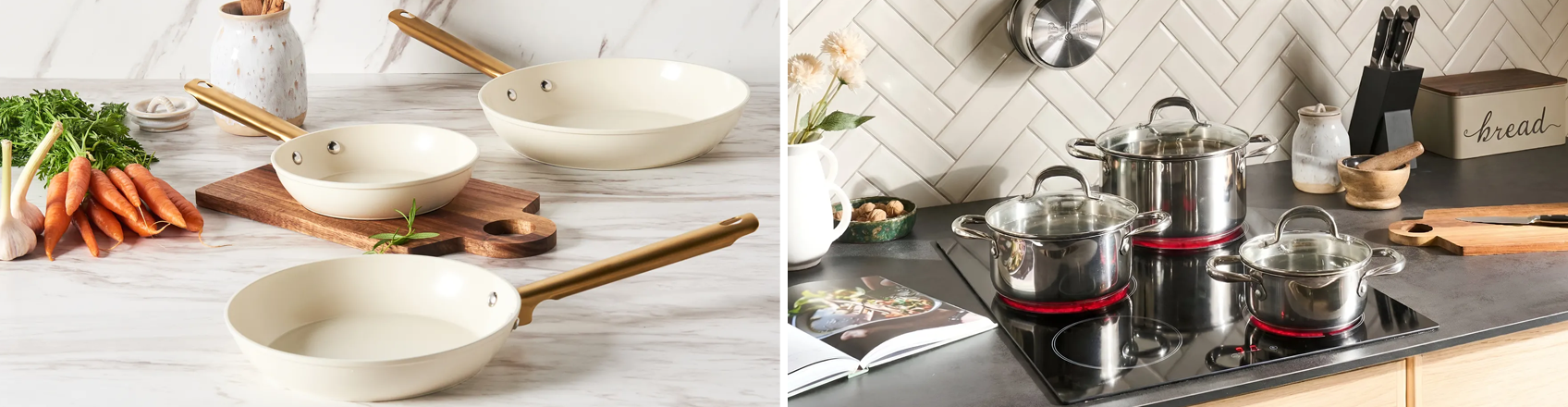
You don't need a large collection of cookware to cook well at home. A few well-chosen pieces in the right sizes will cover the vast majority of everyday cooking without cluttering up the cupboard.
Which pieces do you actually need?
Most households get by comfortably with three or four pieces: a frying pan for everyday cooking, a medium saucepan for sauces and vegetables, and a larger pot for pasta, soups, and stews. Buying a set rather than individual pieces tends to offer better value and keeps sizing consistent, which also makes stacking and storage easier.
What should you look for when choosing cookware?
Material is the most important factor to get right, as it affects how heat is conducted, how the pan responds to temperature changes, and how much maintenance it needs over time.
Stainless steel
Stainless steel is the most durable and versatile option for everyday cookware. It doesn't react with food, holds up well to high heat, and is dishwasher safe in most cases. Look for pieces with an aluminium or copper core in the base, which improves heat distribution and reduces hot spots.
Non-stick
Non-stick coatings are worth having on at least one frying pan. They make cooking delicate foods like eggs and fish much more straightforward, reduce the amount of oil needed, and clean up quickly. Non-stick pans last longer when used with wooden or silicone utensils rather than metal ones, which can scratch the coating over time.
For those who prefer to avoid PFAS-based coatings, there are now several non-stick options made without per- and polyfluoroalkyl substances. These use ceramic or other alternative coatings and perform well for everyday cooking, though they generally benefit from slightly lower cooking temperatures to maintain the surface over time.
Cast iron
Cast iron heats slowly but holds and distributes heat exceptionally well once it reaches temperature, making it ideal for searing, frying, and slow cooking. It's heavy and requires a little more care than stainless steel - it should be dried thoroughly after washing and occasionally seasoned with oil to maintain the surface - but a well-kept cast iron pan can last a lifetime.
Enamelled cookware
Enamelled pots and pans have a cast iron or steel core with a smooth, glassy coating fused to the surface. The enamel eliminates the need for seasoning, doesn't react with acidic ingredients like tomatoes or wine, and makes the cookware significantly easier to clean than bare cast iron. It's a particularly good choice for braises, casseroles, and slow-cooked dishes where the pot goes straight from hob to table.
How do you look after pots and pans properly?
Hand washing generally preserves the finish better than the dishwasher, and letting pans cool before washing helps prevent the base from warping. Always check the individual product page for specific care instructions and hob compatibility before use.
Easy-care cookware
If low-maintenance cooking is a priority, look for pieces that are dishwasher safe, compatible with all hob types including induction, and built without coatings that need special handling. Stainless steel and enamelled cookware are the most straightforward in this regard - they tolerate more robust cleaning and don't require the same attention as non-stick or bare cast iron surfaces.